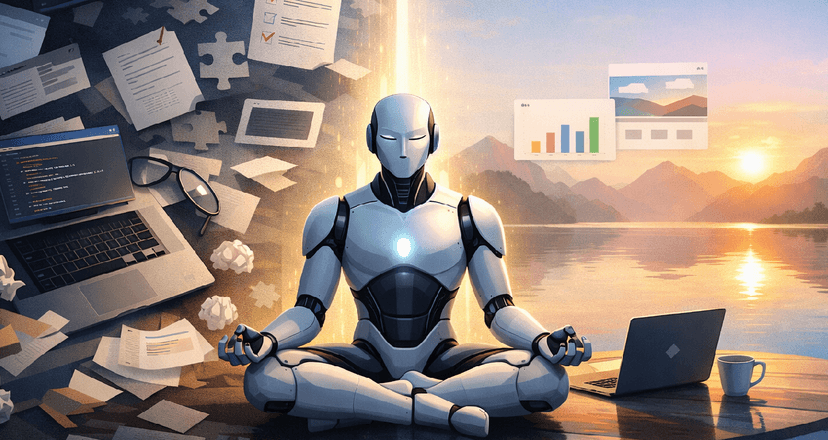
The promise of AI is one of effortless productivity, a world where complex tasks are handled by intelligent agents while we focus on strategy and creativity. Yet, the reality for many is a frustrating cycle of prompt engineering, output correction, and manual integration. Most AI tools are powerful in isolation but fail to connect into a seamless workflow, creating hidden friction that consumes time and energy. You ask for a blog post, you get a draft that needs rewriting. You ask for code, you get a snippet that needs debugging. The AI gives you pieces; you are still left to assemble the final product.
This gap between AI-assisted work and true automation is where the real cost of modern AI tools lies. Instead of a partner, the AI often feels like an intern—capable, but requiring constant supervision. The dream is an autonomous agent that understands a high-level goal and executes it from start to finish. The reality is a series of disconnected tasks that leave the user as the final, overworked integrator. This is the core problem that next-generation AI platforms are trying to solve: moving from simple instruction-following to genuine, goal-driven execution.
Manus AI positions itself as a solution to this very problem. It is designed not as a chatbot or a content generator, but as a fully autonomous agent. The core philosophy is the difference between being “task-bound” and “goal-driven.” While a traditional AI like ChatGPT follows a sequence of instructions, Manus is designed to take a high-level objective—like “build a website for my new coffee shop”—and independently figure out the path, reason through the steps, and deliver a finished product. It’s the difference between giving a cook a recipe and simply asking for dinner.
A Fact-Based Look at Manus AI
Manus AI’s capabilities are built on a foundation of autonomous operation within a sandboxed environment, complete with internet access and the ability to use tools. This allows it to tackle complex, multi-step projects that are impossible for a standard chatbot.
One of its standout features is Wide Research, a parallel multi-agent system designed to overcome the context window limitations that plague other models. When a traditional AI is asked to analyze a large number of items (e.g., 50 competitor products), its performance degrades as the context window fills up. Wide Research avoids this by deploying hundreds of independent agents that work in parallel, each with its own dedicated context. This allows it to process over 250 items with the same level of detail from the first to the last, making it ideal for large-scale market research, data extraction, and competitive intelligence.
Feature | Manus AI | ChatGPT |
Model | Autonomous Agent | AI Assistant |
Execution | Plans and executes complex tasks independently | Follows user-provided instructions sequentially |
Autonomy | High (operates without continuous supervision) | Low (requires constant user direction) |
Output | Production-ready deliverables (apps, reports) | Drafts and suggestions requiring assembly |
Best For | Complex, multi-step workflow automation | Brainstorming, quick answers, content drafting |
Source: Official Manus AI vs. ChatGPT comparison
Industry Comparison: Action-Oriented vs. Advisory
The fundamental difference between Manus AI and other tools like ChatGPT is its orientation toward action. ChatGPT is primarily advisory; it can tell you how to do something, provide code snippets, or draft text. Manus AI is action-oriented; it builds, deploys, analyzes, and completes tasks on the user’s behalf.
For example, if you need a slide presentation, ChatGPT can provide a content outline and text suggestions. You would still need to open a presentation tool, design the slides, and format the content. With Manus Slides, the AI handles the entire process, delivering a fully formatted and visually appealing presentation. This end-to-end completion is the core value proposition.
This approach is not for everyone. The platform is more complex and, with plans starting at $20/month for 4,000 credits, it represents a greater investment than a simple chatbot. It is built for professionals, developers, and businesses who need to automate entire workflows, not just isolated tasks. For those users, the return on investment comes from delegating complete projects, freeing up significant time and resources.
If your goal is to move beyond AI assistance to true AI automation, exploring an agent-based platform like Manus AI is the logical next step. It represents a shift from using AI as a tool to collaborating with it as an autonomous partner.
This article was written by a senior analyst at Crypto University. The information contained herein is for educational purposes only. To explore the platform’s features, you can visit the Manus AI website.
References
[1] Manus AI. (n.d.). Manus vs. ChatGPT. Retrieved from manus.im/compare/vs-chatgpt
[2] Manus AI. (n.d.). Manus AI Documentation. Retrieved from manus.im/docs
[3] Manus AI. (n.d.). Pricing. Retrieved from manus.im/pricing