Key Takeaways |
1. In Web3, your crypto wallet is your identity. Instead of logging in with Google or Facebook, you sign transactions using a private key, giving you full control over your digital presence. |
2. Decentralized Identifiers (DIDs) and the Ethereum Name Service (ENS) allow you to replace long wallet addresses with readable names like "alice.eth" and attach verifiable credentials to your on-chain identity. |
3. Soulbound tokens are non-transferable blockchain tokens used to represent credentials, achievements, and affiliations, forming the foundation of an emerging on-chain reputation system. |
Every time you log into a website using Google or Facebook, you are handing control of your identity to a third party. That company decides what data it collects, how it stores it, who it shares it with, and whether your account stays active. If the platform bans you, changes its policies, or gets hacked, your digital identity is at risk.
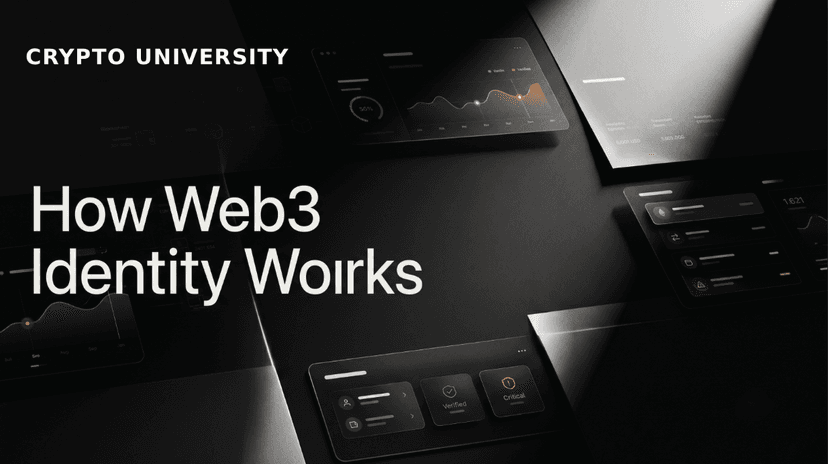
Web3 proposes a different model. Rather than relying on a centralised authority to verify who you are, your identity is anchored to a cryptographic key pair you control. No company stores your profile. No platform can revoke your access. The technical building blocks making this possible are crypto wallets, Decentralised Identifiers (DIDs), human-readable name services like ENS, and a new type of token called a soulbound token.
This article explains how each of these works, what they mean in practice, and where the technology is actually being used today.
The Problem with Web2 Identity
The current internet runs on a model sometimes called "federated identity." You create accounts on platforms, and those platforms become the authority over your digital presence. This creates several well-documented problems:
Data is stored on centralised servers and can be breached, sold, or subpoenaed.
You do not own your account. A platform can suspend or delete it without warning.
Your identity is fragmented across dozens of services with no interoperability.
Logging in with Google or Facebook means those companies track your activity across the web.
Web3 addresses this by making identity self-sovereign: your identity lives in your wallet and on public blockchains, not on a company's server.
Your Wallet as Your Identity
In Web3, a crypto wallet is not just a place to store tokens. It is your primary identifier on the network. When you connect a wallet to a decentralised application (dApp), you are proving ownership of a specific address through a cryptographic signature, not through a username and password.
Here is a side-by-side comparison of how signing into a dApp with a wallet differs from a traditional login:
Feature | Web2 Login (Google/Facebook) | Web3 Wallet Login (MetaMask etc.) |
Identity stored where? | On the platform's server | On-chain, owned by the user |
Who controls access? | The platform | The user (via private key) |
Can you be locked out? | Yes, by the platform | Only if you lose your private key |
Data shared with third parties? | Often, per platform policy | Only what you choose to share |
Verification method | Password or OAuth token | Cryptographic signature |
When you sign a message with your wallet to log into a dApp, you are not sending a password to any server. You are proving you hold a specific private key, and the verification happens entirely on-chain or locally.
What Is a Decentralised Identifier (DID)?
A Decentralised Identifier, or DID, is a globally unique identifier that you control and that does not rely on any central authority. It is a standard developed by the World Wide Web Consortium (W3C) that describes a format for identifiers on blockchains and other decentralised networks.
A DID looks something like this:
did:ethr:0x4e13b5...a7f2
It breaks down as:
did: the scheme, indicating this is a decentralised identifier
ethr: the DID method, indicating which network or system resolves it (in this case, Ethereum)
0x4e13b5...a7f2: the unique identifier, typically a wallet address or cryptographic key reference
Associated with every DID is a DID Document: a small JSON file stored on-chain or in a decentralised storage system that contains public keys, verification methods, and service endpoints. When someone wants to verify your identity, their software fetches your DID Document and uses the public key listed there to confirm your signature.
Crucially, you control the DID Document. You can update it, revoke keys, or add new verification methods. No external authority is required.
ENS: Making Wallet Addresses Human-Readable
One of the practical barriers to on-chain identity is that Ethereum addresses look like this: 0x71C7656EC7ab88b098defB751B7401B5f6d8976b. They are not memorable, easy to share, or pleasant to read.
The Ethereum Name Service (ENS) solves this by allowing users to register a human-readable .eth name and link it to their wallet address. Instead of sharing a 42-character string, you share something like alice.eth.
ENS was launched in May 2017 by Nick Johnson and Alex Van de Sande of the Ethereum Foundation. It works similarly to the internet's Domain Name System (DNS), which translates IP addresses into readable website names, but it operates entirely on smart contracts rather than being controlled by a centralised registry.
How ENS Registration Works
Registering an ENS name involves a few steps:
Go to app.ens.domains and search for your desired .eth name to check availability.
Initiate registration using an Ethereum wallet such as MetaMask. The process uses a commit-reveal scheme to prevent bots from snatching names you requested.
Pay the annual registration fee in ETH. Fees depend on name length: shorter names are significantly more expensive due to scarcity.
Once registered, your .eth name is minted as an ERC-721 NFT on the Ethereum blockchain. You own it, and can transfer, sell, or renew it.
Name Length | Approximate Annual Fee | Why Higher? |
5+ characters | ~$5 USD per year | Most common, highest supply |
4 characters | ~$160 USD per year | Scarcer, higher demand |
3 characters | ~$640 USD per year | Very limited supply |
Fees are denominated in USD but paid in ETH. Actual ETH amounts fluctuate with the market. Always verify current pricing at app.ens.domains before registering.
Once you have an ENS name, it can do more than just replace your wallet address. It can point to multiple cryptocurrency addresses across different chains, link to a website or IPFS-hosted content, and display social handles or profile information. Many Web3 users treat their .eth name as a portable digital identity across protocols.
Soulbound Tokens: On-Chain Credentials That Cannot Be Sold
Standard NFTs are bought, sold, and speculated on. Soulbound tokens (SBTs) are different: they are non-transferable. Once an SBT is issued to your wallet, it stays there permanently. You cannot sell it, give it away, or move it.
The concept was introduced in 2022 in a paper by Vitalik Buterin (co-founder of Ethereum), Glen Weyl, and Puja Ohlhaver, titled "Decentralized Society: Finding Web3's Soul." The name comes from the online game World of Warcraft, where certain items are "soulbound" to a character because they represent personal achievements, not tradeable assets.
The logic for real-world use is straightforward: some credentials should not be transferable. A university degree, a professional certification, or a medical record belongs to you and cannot be legitimately sold to someone else.
What Are Soulbound Tokens Used For?
Use Case | How SBTs Apply | Real Example |
Academic credentials | Universities issue tamper-proof diplomas on-chain | National University of Mongolia issuing blockchain diplomas |
DAO governance | Membership tokens enable one-person, one-vote systems | Optimism Citizens' House grants membership via non-transferable tokens |
Identity verification | Proof of KYC completion without sharing raw data | Binance Account Bound tokens for verified users |
On-chain credit history | Loan and repayment records as verifiable credentials | Emerging DeFi lending protocols exploring reputation-based loans |
Event attendance | Proof of participation that cannot be resold | Community events, hackathons, conference attendance |
An important caveat on privacy: because SBTs live on public blockchains, anyone who knows your wallet address can, in principle, see your credentials and affiliations. This is an active area of discussion among researchers and developers. Privacy-preserving approaches using zero-knowledge proofs are being explored, but the technology is still maturing.
What Does "Owning Your Data" Mean in Practice?
This phrase is frequently used in Web3 marketing, so it is worth being precise about what it does and does not mean.
What it means: You control the cryptographic keys that represent your identity. No company can revoke your access to your wallet. You choose what credentials to disclose and to whom. You can port your on-chain reputation across applications without re-verifying yourself on each platform.
What it does not mean: All of your personal data automatically disappears from existing Web2 systems. Legacy databases, social platforms, and government records still hold your information under their own policies. Web3 identity operates in parallel with the existing internet, not as a wholesale replacement.
The practical benefit is interoperability and portability. If a dApp accepts wallet-based login and you hold the relevant credentials on-chain, you can enter that ecosystem without filling in another form, creating another password, or trusting a new company with your data.
Where This Technology Is Today
The EU Digital Identity Framework (Regulation (EU) 2024/1183) entered into force in May 2024. By late 2026, all 27 EU member states are required to provide at least one compliant digital identity wallet to citizens, with mandatory acceptance by regulated sectors by 2027. This represents a state-led push toward digital identity wallets, though implementation approaches vary between government and decentralised models.
On the blockchain side, adoption is growing but still early. ENS had millions of registered .eth names as of 2024. Soulbound token infrastructure is being deployed by DAOs, credential issuers, and DeFi protocols, but widespread consumer adoption is still in progress.
The technology is most mature in use cases where on-chain verification provides a clear benefit: DAO membership, DeFi access controls, verifiable event attendance, and professional certifications in crypto-native communities.
Ready to Try It Yourself? Confirmed licensed exchanges include OKX, Bybit EU. Set up your first decentralised identity by registering an ENS name. Follow our step-by-step ENS registration guide to get your .eth domain, link it to your wallet, and start building your on-chain presence. |
Frequently Asked Questions
What is a DID in crypto?
A Decentralised Identifier (DID) is a W3C-standardised, globally unique identifier controlled by the user rather than a central authority. It is typically anchored to a blockchain or decentralised storage system and is associated with a DID Document containing public keys and verification methods.
Is my crypto wallet the same as a Web3 identity?
Your wallet address serves as the foundation of your Web3 identity. It is a unique identifier you control. However, a full Web3 identity typically involves additional layers: an ENS name for readability, DIDs for standardised identity claims, and soulbound tokens or verifiable credentials for reputation and certifications.
Can someone steal my ENS name?
Your .eth name is an ERC-721 NFT stored in your wallet. If your private key is compromised, an attacker could transfer it. This is why keeping private keys secure is essential. ENS names are also subject to annual renewal fees. If you fail to renew, the name expires and becomes available to others.
Are soulbound tokens the same as NFTs?
Soulbound tokens share the technical structure of NFTs but remove the ability to transfer or trade them. A standard NFT can be sold on a marketplace. A soulbound token cannot be moved from the wallet it was issued to, making it suitable for representing credentials and achievements rather than tradeable assets.
What is the difference between SSI and a digital ID wallet?
Self-sovereign identity (SSI) is the broader concept of individuals controlling their own identity without relying on centralised authorities. A digital ID wallet is a specific application that stores and manages identity credentials. Government digital wallets, like those being rolled out under the EU Digital Identity Framework, may be SSI-aligned in principle but are state-issued. Blockchain-based wallets like MetaMask are user-controlled but require the user to manage their own keys.
Is Web3 identity actually private?
This depends on implementation. Because most public blockchains are transparent, on-chain activity linked to your wallet is visible to anyone. Soulbound tokens and DIDs are viewable by default. Privacy-preserving techniques using zero-knowledge proofs are being developed to allow selective disclosure, meaning you could prove you hold a credential without revealing its contents. These solutions are still early-stage as of 2025 and 2026.
Disclaimer: This content is for educational and informational purposes only and is not financial advice. Nothing here is a recommendation to buy or sell any asset or use any platform. Do your own research and manage your risk.
AI Agents and Crypto: A Beginner's Guide to Autonomous On-Chain Payments
Top 5 Crypto Exchanges for New Crypto Traders
How to Evaluate a Crypto Whitepaper: A 7-Point Framework for Spotting Vapor from Value
Layer 1 vs Layer 2: Understanding Blockchain Scalability from First Principles
How to Evaluate a Web3 Protocol: An On-Chain Due Diligence Framework