Key Takeaways
A withdrawal is an on-chain transfer, not a database update. Once the transaction is confirmed, no exchange, wallet provider or support team can reverse it, so verification matters more than speed.
The network is the setting people get wrong most often. The receiving wallet decides which network is safe to use, so confirm what the wallet supports before choosing a network on the exchange.
A small test transfer removes most of the risk. Sending a minimal amount first, confirming it arrives, then sending the balance is the single most effective habit for anyone new to self-custody.
What Withdrawing to Your Own Wallet Actually Means
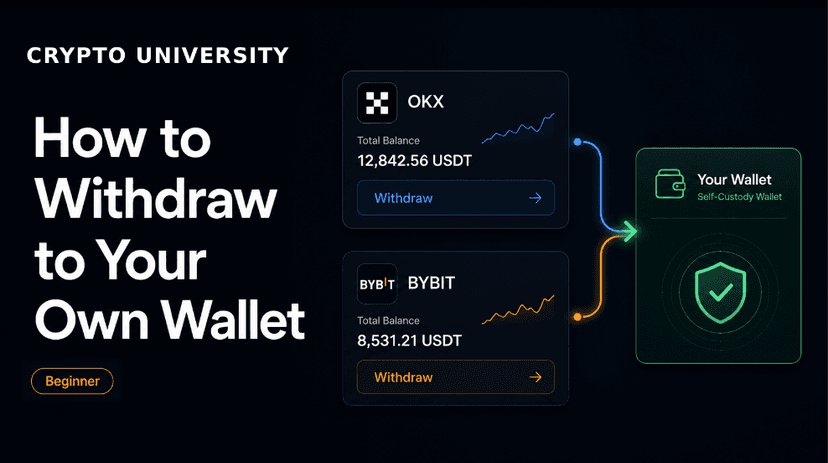
Moving crypto off an exchange is one of the first practical skills a new user needs. While your coins sit on a trading platform, the platform holds the private keys. Your balance is a record in the exchange database, and you are trusting the company to honour that record when you ask for it.
When you withdraw to a wallet you control, the asset moves across the blockchain to an address whose keys only you hold. Two things change at that moment. You gain control of the asset, and you also take on full responsibility for it. Blockchain transactions are final, so accuracy matters more than speed.
One distinction is worth keeping clear. Transfers between two accounts on the same exchange are usually internal, off-chain and free. They are convenient, but they are not withdrawals to self-custody, because the keys never leave the platform.
Before You Start: The Pre-Flight Checklist
Most withdrawal problems are created before the send button is pressed. Work through the checklist below first.
Set up the wallet and back up the recovery phrase. Write the phrase on paper or metal and store it offline. A screenshot, a cloud note or a password manager entry increases exposure.
Confirm the wallet supports the asset and the network. A Bitcoin-only wallet cannot hold Ethereum-based tokens, and a wallet that supports Ethereum does not automatically support every Layer 2 network.
Enable app-based two factor authentication on the exchange account rather than SMS where the platform offers a choice.
Check for withdrawal holds on the account before planning a transfer.
Keep a small amount of the native gas token if you plan to move funds again later. Ethereum tokens need ETH, Tron tokens need TRX, and Solana tokens need SOL to pay for future transactions.
Exchanges apply time-based holds after certain account events. These are security controls rather than penalties, and support teams generally cannot lift them early. The examples below are drawn from published exchange policies and are typical rather than universal. A quick overview of deeper detail on Crypto University: How to Cash Out Crypto
Trigger | Typical effect | Why it exists |
|---|---|---|
Card, Apple Pay or Google Pay purchase | Withdrawal hold of around 72 hours on the purchased amount | Chargeback and stolen card fraud |
Certain bank rails such as ACH or PayPal | Hold of up to 7 days on some platforms | Payment reversal risk |
Password or two factor authentication change | New withdrawal addresses held for around 24 hours | Account takeover protection |
Newly added whitelisted address | Address locked for roughly 24 to 48 hours | Slows down an attacker who gains access |
Large or unusual withdrawal | Manual review, often several hours | Compliance and fraud screening |
Step-by-Step: How to Withdraw Crypto to Your Own Wallet
Open the wallet and choose Receive. Select the exact asset and network you intend to use. The wallet will show a receiving address, and often a QR code.
Copy the address from the wallet itself. Use the copy button. Never type an address by hand, and never reuse an address copied from your own transaction history.
Log in to the exchange and open Withdraw or Send. Some platforms label this Transfer or External Transfer.
Select the asset, then select the network. Match the network to the one the wallet displayed. If the two do not match, stop and resolve the mismatch before continuing.
Paste the address and verify it properly. Compare the full string against the wallet, not only the first and last four characters. If you use a hardware wallet, confirm the address on the device screen.
Add a memo or destination tag only if required. Personal wallets usually do not need one. Leave the field empty if the wallet does not provide a value.
Send a small test amount first. Use the minimum the exchange allows, or a figure small enough that losing it would not matter.
Confirm arrival, then send the rest. Copy the transaction ID, look it up on a block explorer, and wait for it to appear in the wallet before moving the full balance.
The test transfer costs one extra withdrawal fee. Against the risk of sending a full balance to an unusable destination, it is a reasonable trade for anyone doing this for the first time or using a new address.
Choosing the Right Network
Many assets exist on several blockchains at once. USDT on Ethereum and USDT on Tron are the same product from the same issuer, but they are not interchangeable in transit. Sending one to an address that only supports the other is the most common way people lose funds during a withdrawal.
The rule is simple: the receiving side decides. Check what the wallet supports first, then select that network on the exchange.
Asset | Networks you may be offered | What to check |
|---|---|---|
Bitcoin (BTC) | Bitcoin mainnet, Lightning on some platforms | Lightning requires a Lightning-capable wallet and an invoice, not a standard address |
Ether (ETH) | Ethereum mainnet, Arbitrum, Base, Optimism and other Layer 2 networks | Layer 2 withdrawals cost less but only work if the wallet has that network enabled |
USDT or USDC | Ethereum, Tron, Solana, BNB Chain, Arbitrum, Base and others | The wallet must support both the network and the token contract on it |
Solana (SOL) | Solana | Straightforward, but the wallet must be a Solana wallet |
XRP | XRP Ledger | Destination tag may be required by the receiving service |
If the wallet does not list the network you want to use, do not proceed and hope it works. Add the network in the wallet first, or pick a different one. Further reading: What Is a Stablecoin? A Beginner’s Guide to USDT, USDC, and Euro Stablecoins
Memos and Destination Tags Explained
Some blockchains do not create a separate address for every user of a service. Instead, an exchange uses one shared address and routes deposits with a short identifier called a memo, tag or destination tag. Without it, the funds arrive on-chain but the exchange cannot tell whose account to credit.
Chains that commonly use this system include the XRP Ledger, Stellar, Cosmos, TON, Hedera and several Cosmos ecosystem networks such as Injective and Celestia. The important point for this guide: memos matter when you send to an exchange, not usually when you send to your own wallet. A personal self-custody wallet normally generates a unique address, so the memo field stays empty. If the exchange forces you to enter something, check the wallet documentation rather than guessing.
Understanding Withdrawal Fees
Two different costs appear in a crypto withdrawal, and platforms present them inconsistently.
Cost | Who sets it | How it behaves |
|---|---|---|
Network fee | The blockchain, based on congestion | Rises and falls constantly, paid to miners or validators |
Exchange withdrawal fee | The exchange | Often a flat amount per asset and network, updated periodically |
Internal transfer fee | The exchange | Frequently zero, but the transfer stays inside the platform |
Most large exchanges charge a flat fee per withdrawal and absorb the difference when network costs move. That has a practical consequence: many small withdrawals cost more in total than one larger withdrawal, because the flat fee applies each time. It also means the network you choose can change the cost significantly, since fees on high-throughput networks are usually far lower than on congested ones.
Read the fee on the confirmation screen before approving. Some platforms deduct it from the transfer rather than the account balance, so the amount that lands in the wallet is smaller than the figure you entered.
Identity Checks and the Travel Rule
Regulated exchanges apply anti money laundering rules to withdrawals, and this has become more visible since the European Union rules took effect. Under the EU Transfer of Funds Regulation, which sits alongside the MiCA framework, a crypto asset service provider must verify that a customer actually controls a self-hosted wallet address for transfers above 1,000 euros. In practice that means either signing a message with the wallet or receiving a small verification transaction.
Requirements differ by country. In the United States, a proposed FinCEN rule covering self-hosted wallet transfers had not been finalised as of mid 2026. Some platforms also limit self-hosted withdrawals in particular markets as internal policy.
If a verification step appears, complete it inside the exchange interface only. Treat any message asking you to verify a wallet through an outside link as a phishing attempt.
The Highest-Risk Moment: Copying the Address
The gap between copying an address and confirming a transaction is where most avoidable losses happen. Two attacks target it directly.
Address poisoning. An attacker generates an address that closely matches one you use, with the same opening and closing characters, then sends a tiny transaction so it appears in your history. Later, you copy the wrong entry. Security firm Blockaid reported that poisoning attempts on-chain rose sharply through late 2025 and into 2026, and Chainalysis has described the technique as an increasingly common form of fraud in its 2026 crime reporting.
Clipboard hijacking. Malware watches for address-shaped text and silently swaps it after you copy. Check Point Research documented a clipper campaign in June 2026 that carried more than 15,000 attacker-controlled addresses in a single file. A hardware wallet protects your keys, but it cannot stop you from approving a substituted destination.
Four habits defeat both attacks:
Copy addresses from the wallet Receive screen, never from transaction history.
Whitelist the address on the exchange so future withdrawals only go to approved destinations.
Verify the full address on the hardware wallet screen where possible.
Send a test transaction before any meaningful amount.
Common Mistakes and How to Avoid Them
Mistake | What happens | Prevention |
|---|---|---|
Wrong network selected | Funds may be unreachable, or recoverable only through a slow paid support process | Confirm the network in the wallet before choosing it on the exchange |
Missing memo or tag on a deposit | Funds arrive but are not credited | Copy the memo exactly, and expect a support ticket if it is skipped |
Address typed manually | A single wrong character sends funds to an unrecoverable address | Always copy and paste, then verify the full string |
No gas token in the wallet | Tokens arrive but cannot be moved later | Keep a small balance of ETH, TRX, SOL or the relevant native asset |
Whole balance sent on the first attempt | Any error becomes a total loss | Test transfer first, every time |
Withdrawal attempted during a hold | Request is blocked or delayed | Check hold policies before you need the funds |
If Something Goes Wrong
Start with the transaction ID. Look it up on a block explorer for the network you used. If there is no transaction ID, the withdrawal has not left the exchange and the delay is internal. If the transaction exists and is confirmed, the funds have moved and the question becomes where they went.
Wrong network to an exchange address. Sometimes recoverable, because the exchange controls the keys. Binance, for example, publishes a self-service recovery process with a stated fee and a processing window that can run to several weeks for unsupported networks. Other platforms handle these cases manually and make no guarantee.
Missing memo or tag. Usually recoverable through support with the transaction hash, although it can take days.
Sent to an address you do not control. Normally permanent. Report it, but treat recovery as unlikely.
One warning that applies to every scenario: no legitimate service recovers lost crypto for an upfront fee. Accounts that appear in your replies or direct messages offering recovery after a public loss are almost always secondary scams.
After the Withdrawal
Save the transaction ID and label the address in the exchange address book so future transfers are quicker and safer. Keep a record of the date, asset, amount and fee, since tax authorities often expect transfers to be documented even when the movement itself is not a taxable event. If the balance is significant, splitting it across more than one wallet means a single mistake or compromised device does not expose everything.
Frequently Asked Questions
How long does a withdrawal from an exchange take?
Typically minutes to a few hours. The time splits into internal processing by the exchange, which can range from a few minutes to a day if a review is triggered, and blockchain confirmation, which depends on the network and current congestion.
Can I cancel a crypto withdrawal?
Only while it is still pending on the exchange side, and only if the platform offers a cancel option. Once the transaction is broadcast to the blockchain it cannot be cancelled or reversed by anyone.
Do I need a hardware wallet to withdraw?
No. A reputable software wallet is enough to receive funds. Hardware wallets add protection by keeping keys offline and letting you verify the destination address on a separate screen, which matters more as balances grow.
Why is the amount that arrived smaller than the amount I sent?
The withdrawal fee was deducted from the transfer rather than charged separately, or the network fee was higher than expected. Check the confirmation screen breakdown and the transaction on a block explorer.
Is it safe to leave crypto on an exchange?
It is a trade-off rather than a yes or no. Exchanges offer convenience and account recovery, but they hold the keys, which means you carry counterparty risk. Self-custody removes that risk and replaces it with personal responsibility for backups and security. Many users split holdings across both.
What is the minimum I can withdraw?
Each exchange sets a minimum per asset and network, usually set above the withdrawal fee. The figure is shown on the withdrawal screen and can change when network conditions change.
Related Terms
Self-custody wallet. A wallet where the user holds the private keys and no third party can move the funds.
Private key. The secret value that authorises transactions from an address. Whoever holds it controls the asset.
Gas fee. The payment made to a blockchain network to process a transaction, denominated in the network native token.
Address whitelisting. An exchange security feature that limits withdrawals to a pre-approved list of addresses.
Block explorer. A public search tool for viewing transactions, addresses and confirmations on a given blockchain.
Sources
All figures described as reported or estimated reflect published information available at the time of writing, August 2026. Exchange policies, fees and thresholds change, so verify details against the official page for the platform you use.
Kraken Support, withdrawal hold policies, support.kraken.com
Coinbase Help, destination tags and memos, help.coinbase.com
Binance Support, self-service recovery for deposits sent on unsupported networks, binance.com/en/support
CEX.IO Help Centre, recovering incorrect crypto deposits, support.cex.io
Regulation (EU) 2023/1113 on information accompanying transfers of funds and certain crypto-assets (Transfer of Funds Regulation), EUR-Lex
European Securities and Markets Authority and national competent authority guidance on MiCA implementation
Blockaid, research on address poisoning campaigns and on-chain attempt volumes, blockaid.io
Chainalysis, Crypto Crime Report 2026, chainalysis.com
Check Point Research, analysis of Rust-based clipboard hijacking malware, June 2026, research.checkpoint.com
Ledger Academy, crypto security guidance on blind signing and clipboard attacks, ledger.com/academy
Disclaimer: This article is educational. It is not financial, investment, tax or legal advice, and it does not recommend any specific exchange, wallet or asset.
Read More
Explore the Crypto University Cash Out Crypto Guide
How to Cash Out Crypto in South Africa in 2026
How to Cash Out Crypto in the UK in 2026: A Step-by-Step Guide
How to Cash Out Crypto in Dubai in 2026
How to Cash Out Crypto in Nigeria in 2026
How to Cash Out Crypto in Kenya in 2026: A Step-by-Step Guide