Key Takeaways
Crypto tax reporting in 2026 is more organized and closely watched than ever — expect clearer global rules and more visibility from governments.
The biggest mistake most beginners make isn’t missing a tricky rule — it’s simply having messy records.
Smart filing starts long before tax season — good habits, tools, and tracking all year long make everything way easier.
Crypto taxes might not be the most exciting part of trading, but they’re one of the most important if you want to stay out of trouble. As a beginner, you’re probably juggling trades on different exchanges, moving coins between wallets, trying DeFi, earning rewards, and maybe even buying an NFT or two. Months later it can feel impossible to remember what happened when.
The good news? By 2026 things are getting more structured. Governments want better visibility, platforms have to share more data, and there are now solid tools that actually help everyday traders like you stay organized. This guide walks you through everything in plain English — no jargon, no overwhelm.
Why Crypto Taxes Matter More Than Ever in 2026
Crypto is moving into mainstream finance, so tax rules are becoming stricter and clearer across many countries. You can’t ignore them anymore.
Tax Environment Change | Why It Matters for You |
Stronger exchange reporting | Platforms share more of your activity with tax offices |
Better coordination between countries | Fewer loopholes and surprises |
More tax tools available | Easier to sort your records (but you still need to stay tidy) |
The key takeaway is simple: treating crypto taxes like a normal part of your financial life is now basic money smarts — not just something “advanced” traders do.
The Real Problem: Your Activity Is Spread Everywhere
Most stress comes from having bits of your crypto life scattered across many places.
You might have:
trades on centralized exchanges
coins sitting in self-custody wallets
bridges and cross-chain moves
DeFi rewards and staking
NFT buys or token swaps
Without a system, it quickly turns into a mess when tax time arrives. Good record-keeping is the single biggest thing that separates easy filing from total chaos.
Global Rules Differ — But Your Questions Stay the Same
You don’t need to memorize every country’s law. The everyday questions are surprisingly similar everywhere.
Common Question | Why It Matters |
When did you buy or receive the asset? | Sets your cost basis |
When did you sell, swap, or spend it? | Marks a taxable event |
What was the value at that exact time? | Calculates your gain or loss |
Was it a trade, transfer, reward, or payment? | Decides how it’s taxed |
Clean transaction records help you answer these questions no matter where you live.
Transfers vs Taxable Events – Don’t Mix Them Up
This is one of the most common beginner mix-ups.
Action | Usually Taxable? | Why Beginners Get Confused |
Moving coins between your own wallets | No | It looks like something happened |
Selling for cash (fiat) | Yes | Clear “I cashed out” moment |
Swapping one token for another | Often yes | Feels like a trade, not a sale |
Earning rewards or staking yields | Usually yes | It feels like “free money” |
Always label transfers correctly in your records so your numbers stay accurate.
Why Tax Software Is a Game-Changer
Manual tracking works for tiny portfolios, but most real crypto histories are too complicated. Here’s a quick rating of what good crypto tax tools should deliver for beginners (scale 0–5):
Feature | Beginner Rating (0–5) | Why It Helps You |
Exchange imports | 5 | Pulls thousands of trades automatically |
Wallet & DeFi tracking | 5 | Catches activity you might forget |
Cost-basis calculations | 5 | Does the hard math for you |
Transfer matching | 4 | Fixes wallet-to-wallet moves |
Tax report generation | 5 | Ready-to-file summaries in minutes |
These tools don’t replace your review, but they cut the boring work and reduce mistakes.
Your Simple Step-by-Step Filing Workflow
Don’t try to do everything at once. Follow this easy process:
Export all exchange histories early
List your main wallet addresses and big DeFi activities
Import everything into a tax tool
Review and fix any missing transfers
Double-check major sales, swaps, and rewards
Generate reports and go over them (or share with a tax pro)
Breaking it into small steps makes the whole thing manageable instead of overwhelming.
U.S. Taxpayers: Step-by-Step Process
Step | Action | Key Details / Forms |
1 | Gather records | Spreadsheet of all trades/transfers since Jan 1, 2025 Dates, amounts, cost basis, wallet addresses |
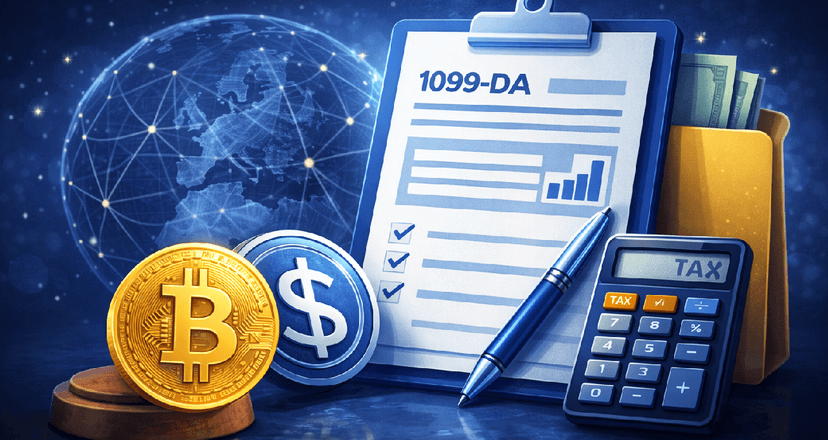
2 | Receive 1099-DA | Sent by exchanges, payment apps, NFT marketplaces, some DeFi platforms |
3 | Match your data | Compare form data vs personal records Contact platform to correct discrepancies |
4 | Report income | Capital gains/losses → Form 8949 + Schedule D Staking/mining income → Schedule 1 |
5 | Keep documentation | Transaction logs, screenshots, statements Retain for at least 7 years (IRS audit window) |
Key Reporting Changes in 2026
Region | Regulation | Start Date | Main Requirement | Affected Platforms |
United States | Form 1099-DA | 2025 tax year (forms in Jan 2026) | Report gross proceeds, cost basis, dates, wallets, tx IDs | Exchanges, payment apps, NFT markets, some DeFi |
European Union | DAC8 | January 1, 2026 | Collect & report user transaction data | Crypto-asset service providers |
Focus on Evidence Quality, Not Just Software Output
Tools are only as good as the data you feed them. Watch out for these common weak spots:
Weak Spot | Why It Hurts Your Taxes |
Missing wallet history | Incomplete picture |
Unmatched transfers | Wrong cost basis or gains |
Wrong token labels | Misclassified income or capital gains |
Blindly trusting defaults | Misses your personal situation |
Always review what the software spits out — you know your story better than any app.
Build Good Habits All Year Round
The traders who have the easiest tax season are the ones who stay organized the whole time. Simple daily habits include:
saving exchange exports regularly
clearly labeling wallets
noting big or unusual transactions
using your tax tool a little each month instead of all at once
avoiding too many random platforms
A bit of structure throughout the year beats a last-minute scramble every time.
Final Thoughts
Crypto taxes in 2026 are more visible and more structured than before — but that doesn’t mean you need to become a tax expert overnight. Stay organized, use reliable tools, track your transfers properly, and treat record-keeping as an all-year habit. Do those things and you’ll sail through filing season way ahead of most people.
FAQ
Why are crypto taxes harder than people expect?
Because your activity gets spread across exchanges, wallets, and DeFi platforms, making it tough to piece everything together later.
Do all countries have the exact same crypto tax rules?
No, but most places ask the same core questions about when you bought, sold, and what the value was.
Are transfers between my own wallets taxable?
Usually not, but you still need to track them correctly so the rest of your records stay accurate.
Is tax software enough by itself?
It’s a huge help for calculations and reports, but you should always review the results yourself.
What’s the best habit for beginner crypto traders?
Keep good records and use a tax tool all year long instead of waiting until the last minute.