Key Takeaways
# | The takeaway |
|---|---|
1 | Stablecoins are the cheapest and fastest way to fund tokenized stocks. Because a dollar-pegged coin matches the dollar-priced token, you skip the bank currency conversion you'd pay funding in your local money. |
2 | USDT has the widest exchange pair coverage, while USDC leads for onchain trading. On Kraken, xStocks bought with USD or USDG skip the trading fee (only a spread applies). |
3 | Spending or selling a stablecoin can count as a taxable event even though its price barely moves, so keep a record of every step. |
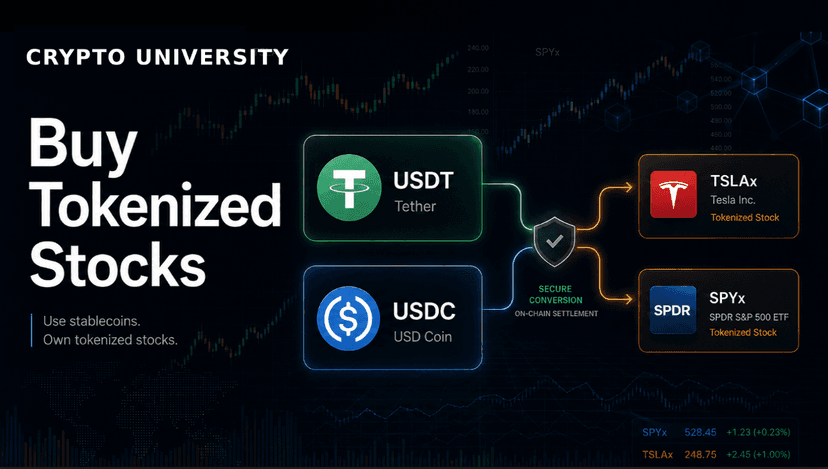
If you already hold USDT or USDC, you're holding the perfect currency for buying tokenized stocks. Most of these products are priced in US dollars, they trade against stablecoin pairs on almost every platform, and the whole idea, owning stock exposure on crypto rails, assumes you're funding from crypto in the first place. This guide walks you through the stablecoin route from start to finish, including the tax detail a lot of guides quietly leave out.
Why Stablecoins Fit Tokenized Stocks
For most people, and especially anyone outside the US, funding with stablecoins is the cheapest and fastest option. Here's why.
The benefit | What it means for you |
|---|---|
No currency conversion fees | Tokenized US stocks are priced in dollars, and a dollar-pegged stablecoin already matches that. You skip the bank conversion you'd trigger funding in euros, naira, or dirhams. You still carry US dollar exposure inside the position, but that's just normal international investing. |
You're already set up | If your USDT sits on Kraken or your USDC is in a Phantom wallet, you're one transaction away from owning a stock token like TSLAx. No bank wire, no card, no waiting for settlement. |
Nearly every venue supports them | USDT is the standard pairing on most exchanges that list tokenized stocks. USDC and USDG are widely accepted too, and Kraken charges no trading fee on xStocks bought with USD or USDG (a spread still applies). |
Compare tokenized stocks. Want to see which stablecoin pairs each platform offers for a given stock? The Crypto University Tokenized Stocks Directory lays it out asset by asset.
Buying on an Exchange
This is the simplest path if you're new. You're buying the stock token the same way you'd buy any other coin on a centralized exchange.
Move stablecoins onto the exchange. Deposit the USDT or USDC you already hold, or buy some on the platform. Make sure the network you send on matches the exchange's deposit address. Sending USDC on the wrong chain is the classic, costly beginner mistake.
Find the token's stablecoin pair, such as TSLAx/USDT or SPYx/USDT.
Use a limit order. Order books can be thin outside market hours, so set your price and let the market come to you rather than buying whatever's on offer.
Watch the fees. On Kraken, USDG/USD orders for xStocks skip the trading fee and only cost you the spread. On other venues, compare the USDT and USDC pairs, since their spreads can differ.
Buying Onchain on a DEX
Swapping stablecoins for stock tokens on a decentralized exchange (a DEX) is the purest version of the whole idea: your dollars and your equities live on the same blockchain.
Hold USDC or USDT on the same chain as the token. For xStocks that's USDC on Solana, traded through Jupiter. For Ondo tokens it's USDC on Ethereum, through MetaMask Swaps.
Double-check the token's contract address using the issuer's official documentation before you swap. This protects you from copycat tokens.
Set your slippage carefully and check the price impact. Thin liquidity pools can move against you on large swaps, so go deliberately.
Swap your stablecoin for the stock token. It happens in a single transaction. Just keep a little of the chain's native token on hand to cover gas fees.
USDT or USDC: Which Should You Pick?
Both work, and for this purpose the difference is small. The quick answer: use whichever you already hold and whichever gives you the tighter pair on your platform. Here's how they compare.
USDT | USDC | |
|---|---|---|
Best for | The widest exchange pair coverage; it dominates many non-US venues. | Onchain trading and US-adjacent DeFi, where it's the more common quote asset. |
Reserve profile | Highly liquid and widely accepted everywhere. | Often preferred for its regulated, fully-reserved profile. |
Simple rule | Reach for it when it offers the tighter pair on your exchange. | Reach for it when you're trading onchain or already hold it. |
Choosing fresh? Check a stablecoin directory for backing, network support, and where each one trades best. One thing to avoid: obscure algorithmic or thinly-backed stablecoins. You don't want to stack stablecoin risk on top of the risk you're already taking with tokenized stocks.
The Tax Detail Most Guides Skip
Here's the part a lot of guides gloss over. In many countries, spending a stablecoin to buy a tokenized stock counts as selling that stablecoin, which is a taxable event. The price barely moves, so any gain is usually tiny or zero, but the transaction may still need reporting. The table below shows where the tax moments hide.
What you do | Why it can matter for tax |
|---|---|
Spend a stablecoin to buy a stock token | In many places this is treated as disposing of the stablecoin. The gain is usually tiny, but the transaction may still be reportable. |
Sold appreciated crypto earlier to get the stablecoin | That earlier sale was likely the real taxable event, so don't forget it. |
Sell the stock token back into a stablecoin later | That's another disposal to record. The stable price shrinks the gains, not the paperwork. |
The takeaway is simple: keep records of each leg, and confirm the rules with a local tax professional. Stablecoins being stable makes the gains small, not the reporting optional.
Before You Place Your First Order
If you remember nothing else: stablecoins are the fastest, cheapest way into USD-priced tokenized stocks. USDT gives you the widest exchange pairs, USDC leads onchain, and on Kraken USDG/USD orders skip the trading fee. Always match the network when you deposit, verify the token contract when you buy onchain, and log every buy and sell for tax time.
Frequently Asked Questions
Can I buy tokenized stocks directly with USDT?
Yes. USDT is the default quote asset on most venues that list tokenized stocks, including OKX, Bybit, and Gate, and USDT pairs exist on DEXs too. Just deposit or hold USDT, then trade the token's USDT pair.
Is USDC or USDT better for buying stock tokens?
They're functionally similar. Choose USDT for the widest exchange coverage, and USDC for onchain trading or if you prefer its reserve profile. In practice, use what you already hold and whichever pairs tightest on your platform.
Do I pay currency conversion fees when I use stablecoins?
Not at the funding step, because a dollar-pegged stablecoin already matches the dollar-priced token. You do still hold US dollar exposure inside the position, and converting your local currency into stablecoins earlier had its own cost.
Is buying a stock token with a stablecoin taxable?
Often, yes. Spending the stablecoin can count as a disposal (usually with a negligible gain) and may be reportable, and selling back later is another disposal. Stability shrinks the gains, not the reporting. Check with a local adviser.
Which chain should I use for stablecoin purchases?
Match the token. Use USDC on Solana for xStocks, and USDC on Ethereum for Ondo. Fees tend to favor Solana, so always confirm the token's chain first.
References
Source | Link |
|---|---|
Kraken xStocks (no fee on USD/USDG orders) | |
OKX unified tokenized stocks (USDT pairs) | |
xStocks docs (contracts, chains) | |
MetaMask RWA / Ondo access |
Disclaimer: This content is for educational and informational purposes only and is not financial advice. Nothing here is a recommendation to buy or sell any asset or use any platform. Do your own research and manage your risk.
Explore The Crypto University Tokenized Stocks Directory.
Tokenized Stocks Explained: A Simple Guide for Beginner Traders
How to Buy Tokenized Stocks: A Step by Step Guide for Beginners
Best Platforms for Tokenized Stocks: Exchanges, Brokers and Onchain Apps