Key Takeaways
|
What Just Happened?
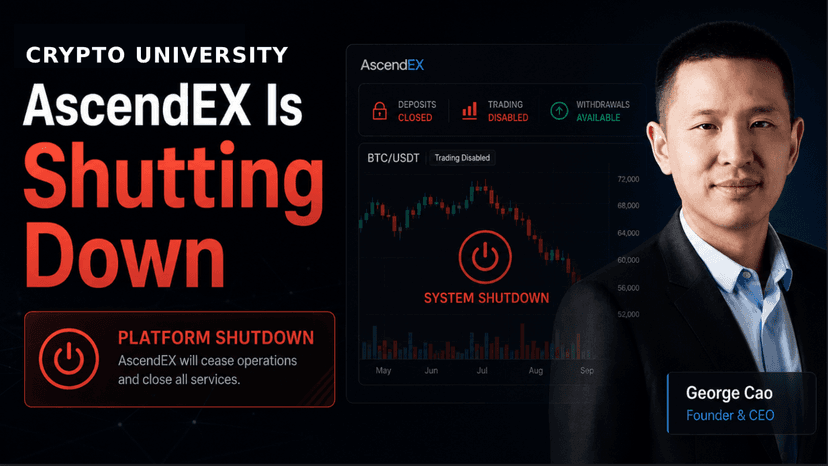
AscendEX, the centralized cryptocurrency exchange previously known as BitMax, has stopped operating as a normal trading platform. The company says it ceased operations with effect from 1 July 2026. Users can no longer open accounts, make deposits, trade, swap assets, stake, lend or join promotional programmes. The platform is now intended mainly for limited offboarding functions, such as submitting withdrawal requests, updating identity information, contacting support and exporting transaction history.
The most important issue is withdrawals. On 6 July 2026, AscendEX paused automated withdrawals and placed every request into a manual review process. Reviews may include identity checks, anti-money-laundering and sanctions screening, fraud checks, balance reconciliation, blockchain network availability and possible legal or insolvency-related requirements. The exchange explicitly said it could not provide assurances about when requests would be processed or how much could ultimately be paid.
AscendEX cited several pressures rather than one simple cause. Its notice referred to European regulatory developments, including the end of the longest possible MiCA transitional period on 1 July 2026 for some previously operating crypto service providers. It also cited wider regulatory, financial and operational considerations. Separately, the company said it had relied on a strategic transaction that was expected to provide liquidity, but the unnamed counterparty did not perform.
This distinction matters. MiCA was already broadly applicable to crypto-asset service providers from 30 December 2024. However, Article 143 allowed qualifying firms in participating EU member states to continue under national transitional arrangements until no later than 1 July 2026, or until authorization was granted or refused. AscendEX’s wording should therefore be understood as referring to the final transition deadline and its lack of authorization, not the start date of the whole MiCA framework.
The Closure Timeline at a Glance
Date | Development | Why It Matters |
2018 | BitMax launches as a centralized exchange. | The platform enters the market during a period of rapid exchange growth. |
22 March 2021 | BitMax rebrands as AscendEX. | The company positions itself as a broader crypto financial platform. |
3 November 2021 | AscendEX announces a US$50 million Series B round led by Polychain Capital and Hack VC. | The funding supports expansion shortly before a major security incident. |
11 December 2021 | Hot wallets are compromised across Ethereum, BNB Smart Chain and Polygon. Outside estimates put the loss near US$77.7 million. | The incident becomes an important part of the exchange’s security history. |
Late June 2026 | Users and on-chain researchers report withdrawal delays and low balances in known hot wallets. | These were warning signs, but public wallet observations alone could not prove the company’s full financial position. |
1 July 2026 | AscendEX ceases operations. | Trading and most services stop. |
6 July 2026 | Automated withdrawals pause and manual review begins. | Users lose access to normal, instant withdrawal processing. |
10 July 2026 | AscendEX says it is preserving user account and transaction records. | The exchange warns users to rely only on its official status page and channels. |
Where AscendEX Came From
AscendEX began in 2018 under the name BitMax. It was founded by a team that promoted experience in quantitative finance and Wall Street trading. Like many centralized exchanges launched during that period, it tried to serve both retail and professional users through spot markets, margin products, derivatives, staking and other yield-related services.
The 2021 rebrand from BitMax to AscendEX reflected an ambition to become more than a basic exchange. The company marketed itself as a bridge between centralized trading and decentralized finance. In November 2021, it announced a US$50 million Series B funding round led by Polychain Capital and Hack VC, with participation from several other investors.
Only weeks later, AscendEX disclosed unauthorized transfers from hot wallets. Security researchers estimated losses of approximately US$77.7 million across Ethereum, BNB Smart Chain and Polygon. AscendEX said affected users would be compensated. The exchange continued operating for several years after the incident, so the 2021 hack did not immediately cause the 2026 closure. Still, it belongs in the platform’s longer risk history because major security events can create lasting operational and financial costs.
Where It Went Wrong
There is not enough verified public information to identify one definitive cause. The official notice points to a combination of regulatory pressure, financial stress, operational constraints and a failed strategic transaction. Each factor may have reinforced the others.
1. No MiCA authorization for continued EU service
AscendEX stated that it did not hold authorization under MiCA. At the end of an applicable transitional period, a provider without authorization generally cannot continue offering covered crypto services in the EU. Regulation alone does not explain every withdrawal problem, but it can remove access to markets, payment relationships and revenue at a difficult time.
2. A failed liquidity transaction
The exchange said it relied on an agreed strategic transaction that was supposed to provide liquidity for growth, but the counterparty failed to perform. No counterparty, amount or contract terms were disclosed. Because these details remain unknown, readers should avoid treating speculation about the deal as fact.
3. Signs of withdrawal and liquidity stress
Before the formal closure notice, users reported delayed withdrawals. On-chain investigator ZachXBT also highlighted low balances in wallets publicly associated with AscendEX. These observations were meaningful warning signals, but exchange wallets are complex. A visible hot wallet is not the same as a complete proof-of-reserves statement, audited balance sheet or list of liabilities. The stronger evidence of financial stress comes from AscendEX’s own statement that it is assessing its financial position and cannot guarantee withdrawal timing or amounts.
4. The possibility of insolvency
AscendEX has not stated that a formal insolvency process has definitely begun. It has, however, warned that unresolved balances or claims could become subject to such a process if one starts. This is important because an account balance displayed on a centralized exchange is normally a claim against the operator, not the same thing as controlling crypto in a self-custody wallet.
What This Means for You as a Trader
For users with assets on AscendEX, the situation is now an offboarding and record-preservation problem rather than a trading decision. Normal market features are unavailable, and users should not attempt to deposit more assets in the hope of unlocking an account or speeding up a withdrawal.
Centralized exchange balance | Self-custody wallet balance |
The operator controls the private keys. | You control the private keys or recovery phrase. |
Withdrawals depend on the platform’s systems, policies and financial condition. | Transactions depend mainly on the blockchain and your wallet security. |
Your dashboard balance may represent a contractual claim against the company. | The blockchain records assets at an address you control. |
Exchange failure can delay access or lead to a formal claims process. | Loss usually comes from key theft, scams, signing mistakes or lost recovery information. |
This does not mean every user should keep every asset in self-custody at all times. Self-custody also creates serious responsibilities. The broader lesson is to match storage methods to purpose. An exchange may be useful for buying, selling or converting assets, while long-term holdings may require a different custody plan. Diversifying operational exposure and testing withdrawals before transferring large amounts are basic risk-management habits, not guarantees.
Your Practical Checklist
Do not deposit additional crypto or fiat. Ignore anyone who claims a new deposit is required to release your balance.
Log in through the official website or app and record every displayed balance. Take dated screenshots and save them in more than one secure location.
Update KYC information if the official account flow requests it. Use only the platform’s official interface and published support channel.
Submit a withdrawal request through the official withdrawal process. Confirm the destination address and network carefully before submitting.
Export transaction history, deposits, withdrawals, trades, fees and tax records. Save files in common formats such as CSV or PDF where available.
Preserve evidence. Keep ticket numbers, emails, timestamps, screenshots, wallet addresses, transaction hashes and copies of the terms that applied to your account.
Disable or rotate API keys connected to AscendEX. Stop trading bots and remove AscendEX credentials from portfolio tools where practical.
Watch for recovery scams. AscendEX says staff and founders will not provide account-specific instructions through private messages or unofficial social channels.
Use the correct regulator or dispute channel for your jurisdiction if necessary. Rules differ by country, so obtain qualified legal advice for significant claims.
Continue checking the official status page. Do not rely on social posts that promise priority processing, guaranteed recovery or insider access.
A useful evidence folder should contain your account identifier, verified contact details, balance snapshots, transaction exports, withdrawal request details, support correspondence and any on-chain transaction records. Avoid publishing sensitive documents or complete identity information in public forums.
The Full List of Confirmed MiCA-Licensed Exchanges
Here is a quick overview of every confirmed MiCA-licensed consumer exchange on MICA tracker, followed by deeper detail on How to Cash Out Crypto.
Exchange | Licensed Entity | Regulator | Country | Services |
|---|---|---|---|---|
OKX Europe Limited | MFSA | Malta | Trading, Exchange, Custody | |
Bybit EU | Bybit Technology Austria GmbH | FMA | Austria | Trading, Exchange |
Coinbase | Coinbase Financial Services Ltd | CSSF | Luxembourg | Trading, Exchange, Custody |
Kraken | Payward Europe Limited | CBI | Ireland | Trading, Exchange, Custody |
Bitstamp | Bitstamp Europe S.A. | CSSF | Luxembourg | Trading, Exchange |
Binance | Binance France S.A.S. | AMF | France | Exchange, Trading |
Bitpanda | Bitpanda GmbH | FMA / MFSA | Austria / Malta | Trading, Exchange, Custody, Brokerage |
Bitvavo | Bitvavo B.V. | AFM | Netherlands | Trading, Exchange |
Foris DAX Europe | MFSA | Malta | Trading, Exchange, Custody | |
Gate Technology Ltd | MFSA | Malta | Trading, Exchange | |
Interactive Brokers | Interactive Brokers Ireland Ltd | CBI | Ireland | Exchange, Trading |
Frequently Asked Questions
Is AscendEX permanently closed?
AscendEX says it ceased operations on 1 July 2026. Normal exchange services are unavailable. Limited access may remain for withdrawals, KYC updates, complaints, support and record exports, subject to platform and legal constraints.
Can users still withdraw crypto from AscendEX?
Users can submit requests through the official process, but automated withdrawals are paused. Every request is manually reviewed, and the company has not guaranteed timing or amounts.
Why did AscendEX shut down?
The company cited MiCA authorization issues, wider regulatory, financial and operational pressures, difficult market conditions and the failure of an expected strategic liquidity transaction.
Did MiCA begin on 1 July 2026?
No. MiCA became broadly applicable to crypto-asset service providers on 30 December 2024. The date 1 July 2026 was the latest possible end of certain national transitional arrangements for qualifying existing providers.
Is AscendEX insolvent?
The company has said it is assessing its financial position and has warned that a formal insolvency process could affect unresolved balances. It has not, in the reviewed notice, confirmed that such a process has begun.
Should users pay a recovery agent?
Be extremely cautious. Do not share passwords, two-factor authentication codes, seed phrases or private keys. AscendEX has warned that official account instructions will not come from staff, founders or private social-media messages.
What records should users download?
Download transaction history, deposits, withdrawals, trades, fees, account statements and tax records. Also save balance screenshots and all support correspondence.
What is the main lesson from the closure?
Centralized exchanges create counterparty and withdrawal risk. Users should understand who controls the keys, limit unnecessary exchange balances, preserve records and maintain a tested custody plan.
Sources
1. AscendEX official status page, notices dated 6 July and 10 July 2026. Open source
2. ESMA, MiCA Article 143 transitional measures and MiCA overview. Open source
3. AscendEX announcement of US$50 million Series B funding, 3 November 2021. Open source
4. CoinMarketCap AscendEX exchange profile and historical security summary. Open source
5. Crypto Briefing report on June 2026 withdrawal warnings and public hot-wallet observations, 8 July 2026. Open source
Disclaimer: This content is for educational and informational purposes only and is not financial advice. Nothing here is a recommendation to buy or sell any asset or use any platform. Do your own research and manage your risk.
Best Crypto Trading Competitions in 2026: OKX vs Bybit
Best Robinhood Chain Trading Platforms in 2026: FOMO, GMGN, Uniswap and OpenSea Compared
Best RugCheck Alternatives Every Beginner Trader Needs
RugCheck Explained: How Beginners Can Use This Free Solana Token Safety Tool