
Key Takeaways
Lean Ethereum is a multi-year technical overhaul proposed by Ethereum co-founder Vitalik Buterin to simplify the protocol while addressing long-term challenges in scalability, privacy, and security against future quantum computers.
The plan treats quantum resistance and privacy as first-class priorities and centers on using recursive STARK proofs for efficient verification instead of re-executing every transaction.
Changes will roll out gradually over roughly 3–4 years through a series of network upgrades, with strong developer support for the direction but ongoing discussion about implementation speed.
What Is the Lean Ethereum Roadmap?
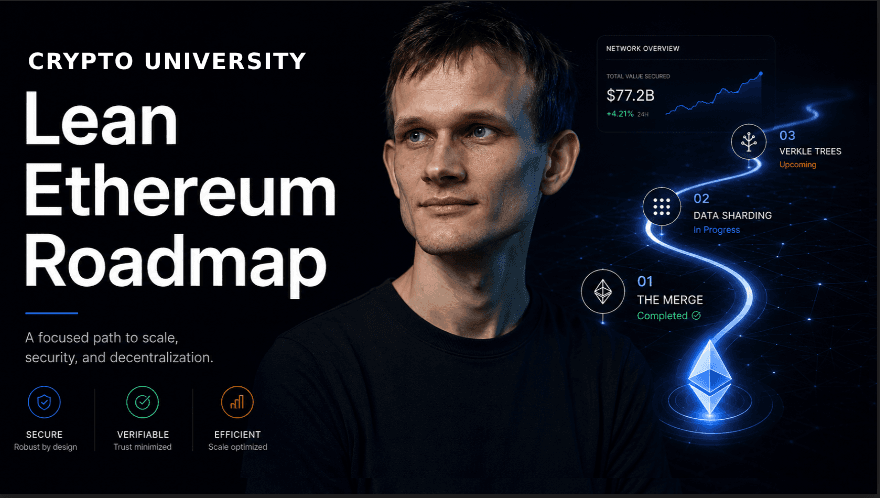
Lean Ethereum refers to an updated long-term technical vision for Ethereum outlined by Vitalik Buterin in early July 2026. It describes a coordinated set of protocol changes expected to span approximately three to four years. Buterin has described it as Ethereum’s “third major iteration” — comparable in scope to the 2022 Merge that transitioned the network from proof-of-work to proof-of-stake.The roadmap is presented as a “strawmap” (a draft planning document) hosted at strawmap.org. It covers nearly every major layer of the Ethereum protocol: consensus, data availability, and execution. The goal is a simpler, more efficient, more private, and future-proof base layer.The vision builds on earlier ideas but elevates certain priorities. Quantum resistance has moved much higher on the list, and privacy is now treated as a core design requirement rather than an optional add-on.
Why Pursue These Changes?
Ethereum has grown significantly since the Merge. Layer-2 networks handle most user activity, but the base layer still faces limitations in throughput, costs for certain operations, and long-term security assumptions.Current cryptography (such as BLS signatures and elliptic curve methods) could become vulnerable to sufficiently powerful quantum computers in the future. While no such computers exist today for breaking these systems at scale, preparing now reduces risk.Privacy has also become more important. Many users and applications want stronger guarantees without relying on external intermediaries. At the same time, developers and researchers want a simpler protocol that is easier to maintain, formally verify, and scale over decades.Lean Ethereum aims to address these areas together rather than in isolation.
Key Priorities
Quantum Resistance
Quantum computers threaten certain types of cryptography used today. The roadmap calls for replacing vulnerable components with post-quantum alternatives, particularly for signatures and data commitments (such as those used for blobs that support Layer-2 scaling).Work is already underway on post-quantum key registries and hash-based signature schemes. Designing blobs and other data structures to be quantum-safe from the start is described as urgent.
Privacy as a First-Class Goal
Privacy is no longer viewed as something to add later. New protocol elements (such as changes to the mempool, state structures, or data formats) are now evaluated with privacy in mind — specifically “quantum-safe, intermediary-free privacy protocol transactions.”This direction supports shielded or private transactions directly at the base layer where feasible.
Scaling and Efficiency
The plan targets higher throughput and lower costs through multiple levers:
Larger gas limits and more blob capacity over time.
More efficient verification using recursive STARK proofs.
Potential changes to finality (how quickly transactions are considered irreversible).
Redesign of state storage to keep the “dynamic” (frequently changing) state manageable while adding scalable new state types.
North-star goals mentioned in related planning include fast Layer-1 finality (seconds), gigagas-per-second capacity on Layer 1 in the long term, and even higher effective throughput on Layer 2.
Major Technical Components
The roadmap organizes changes around three main layers, often referred to with “Lean” prefixes in discussions:Lean Consensus — Redesign of the consensus layer (building on the Beacon Chain). Goals include faster finality (one- or two-round in some designs), stronger security properties, and post-quantum signature schemes (such as hash-based leanSig and aggregation methods). Early devnets have already tested elements of this work.Lean Data — Improvements to data availability (blobs and related structures). Focus includes post-quantum cryptography and more flexible or granular data handling to better support Layer-2 growth.Lean Execution — Changes to how smart contracts and transactions are processed. This may involve a more minimal, SNARK/STARK-friendly virtual machine (possibly based on RISC-V or a custom leanISA) alongside or eventually replacing parts of the current Ethereum Virtual Machine (EVM). Existing EVM applications would likely continue via compilation layers.A central technical shift across these areas is making recursive STARK proofs a core, enshrined part of the protocol. Instead of every node re-executing every transaction, nodes can verify compact cryptographic proofs. This approach supports both scaling and formal verification.State architecture is also being reconsidered: keeping the flexible dynamic state while adding restrictive, highly scalable state types (with targets discussed in the hundreds of terabytes range over time).
Timeline and Implementation Path
The changes are not expected as one single upgrade. Instead, they will arrive through a sequence of hard forks over the coming years.
Near-term upgrades (such as Glamsterdam) are expected to include gas limit increases and other scaling steps.
Hegotá (sometimes called H-star) has been described as likely the last major “pre-Lean” themed fork.
Subsequent forks will carry a stronger Lean focus.
Significant milestones, including aspects of post-quantum infrastructure and faster finality, are targeted in the 2028–2029 timeframe.
Related development tracks, such as Lean Consensus devnets, have already progressed through multiple test phases with different client implementations.The overall window is described as three to four years, though some researchers have noted that tools like large language models could potentially accelerate parts of the research and implementation process.
Community and Developer Response
Ethereum researchers and client developers have generally welcomed the direction. Many describe the technical ideas — particularly the central role of recursive STARKs, stronger privacy focus, and quantum safety — as ambitious and well-aligned with long-term needs.At the same time, a common point of discussion is execution speed. Several prominent voices have called the proposed 3–4 year timeline too slow for certain priorities (especially quantum readiness) and have encouraged faster progress where possible.The roadmap remains a draft and coordination tool rather than a fixed schedule. Actual delivery depends on research progress, client implementation, testing, and the Ethereum community’s consensus process.
Potential Impact on the Ecosystem
Successful execution of these upgrades could strengthen Ethereum’s technical foundation for the long term. A simpler, more verifiable protocol with built-in privacy options and better scaling characteristics may support continued growth of Layer-2 networks and decentralized applications.For users, the most noticeable effects would likely appear gradually: potentially lower fees for certain operations, faster confirmations in some cases, and new privacy capabilities where adopted by applications. Quantum resistance provides a form of future-proofing rather than an immediate user-facing change.Developers building on Ethereum may eventually work with new tools and execution environments that are more proof-friendly, while the existing EVM ecosystem continues in parallel during transition periods.As with any major protocol evolution, there are risks around coordination, implementation complexity, and ensuring backward compatibility where needed.
FAQ
What exactly is “Lean Ethereum”?
It is the name given to Vitalik Buterin’s updated long-term vision and draft roadmap for overhauling major parts of the Ethereum protocol over the next 3–4 years, with emphasis on simplicity, quantum resistance, privacy, and scaling.
When will these changes happen?
There is no single date. Upgrades are expected to roll out progressively through multiple network forks starting in the second half of 2026 and continuing through 2029, according to current planning documents.
What are STARK proofs and why do they matter here?
STARKs (Scalable Transparent Arguments of Knowledge) are a type of cryptographic proof that allows verification of computations without re-running them. Making recursive STARKs a core part of Ethereum enables more efficient scaling and verification.
Will my existing Ethereum apps or tokens break?
The roadmap emphasizes maintaining compatibility. Existing applications are expected to continue functioning, potentially through compilation layers if execution environments evolve. Major changes are designed with careful transition planning.
How does quantum resistance protect Ethereum?
It involves replacing cryptography that could theoretically be broken by future quantum computers with post-quantum alternatives (such as certain hash-based signature schemes). This is a proactive measure.
Where can I follow progress?
Official sources include Ethereum Foundation research channels, client team updates, ethresear.ch discussions, and the strawmap at strawmap.org. Lean Consensus work also has dedicated development tracking.
Disclaimer: This content is for educational and informational purposes only and is not financial advice. Nothing here is a recommendation to buy or sell any asset or use any platform. Do your own research and manage your risk.
AI Agents in Crypto Wallets: Technical Foundations and Security Considerations
Tokenized Assets Go Institutional: What Standard Chartered's 2028 Projection Means for Web3 Learners