# | Takeaway |
1 | Cross-chain bridges let you move assets between blockchains, but they add extra security and counterparty risk on top of the chains themselves. |
2 | The two main types are lock-and-mint bridges and liquidity pool bridges. They solve the same problem in very different ways, and each has its own weak spots. |
3 | Before you bridge, check who validates the transfers, how deep the liquidity is, what kind of token you actually receive, and watch for clear red flags. |
Introduction
If you have spent any time in crypto, you have probably heard people talk about bridging tokens from one chain to another. Maybe you wanted to move USDC from Ethereum to Arbitrum to save on fees, or shift some assets to Solana to try a new app. That is exactly what cross-chain bridges are built to do.
Bridges are a big part of how the crypto world stays connected. Without them, every blockchain would feel like its own walled garden, and you would have far fewer options for trading, lending, or using new apps.
Here is the catch. Bridges are useful because they connect chains, but they are risky for the same reason. They sit in the middle, and that middle position has been hit by some of the largest hacks in crypto history.
So the real question for everyday traders is not just how do crypto bridges work. The more useful question is how do you tell if a bridge is safe enough for your money before you click confirm. This guide walks you through it in plain language.
What Is a Cross-Chain Bridge?
A cross-chain bridge is a system that moves value from one blockchain to another.
Different blockchains do not naturally talk to each other, so a bridge has to build a process that links the two sides. In most cases, the bridge does one of two things:
It locks an asset on one chain and creates a copy of it on another chain. Or it uses pools of money already sitting on both chains to complete the transfer.
So when someone says they are sending tokens across chains, that is not literally what is happening. The original token usually stays put, and the bridge either creates new tokens on the other side or releases tokens from a pool, all under a set of rules.
Why People Use Bridges
Reason | What It Means |
Lower fees | Move from a chain with high gas to a cheaper one |
New apps | Use protocols that only live on certain chains |
Stablecoin movement | Shift USDC, USDT, or DAI into a different ecosystem |
Better liquidity | Trade where order books or pools are deeper |
Network access | Reach yields, NFTs, or tools tied to a specific chain |
Bridges solve real problems. But every bridge adds a new layer of trust, and that layer needs checking before you use it.
The Two Main Bridge Models
Most bridges you will run into use one of two designs.
1. Lock-and-Mint Bridges
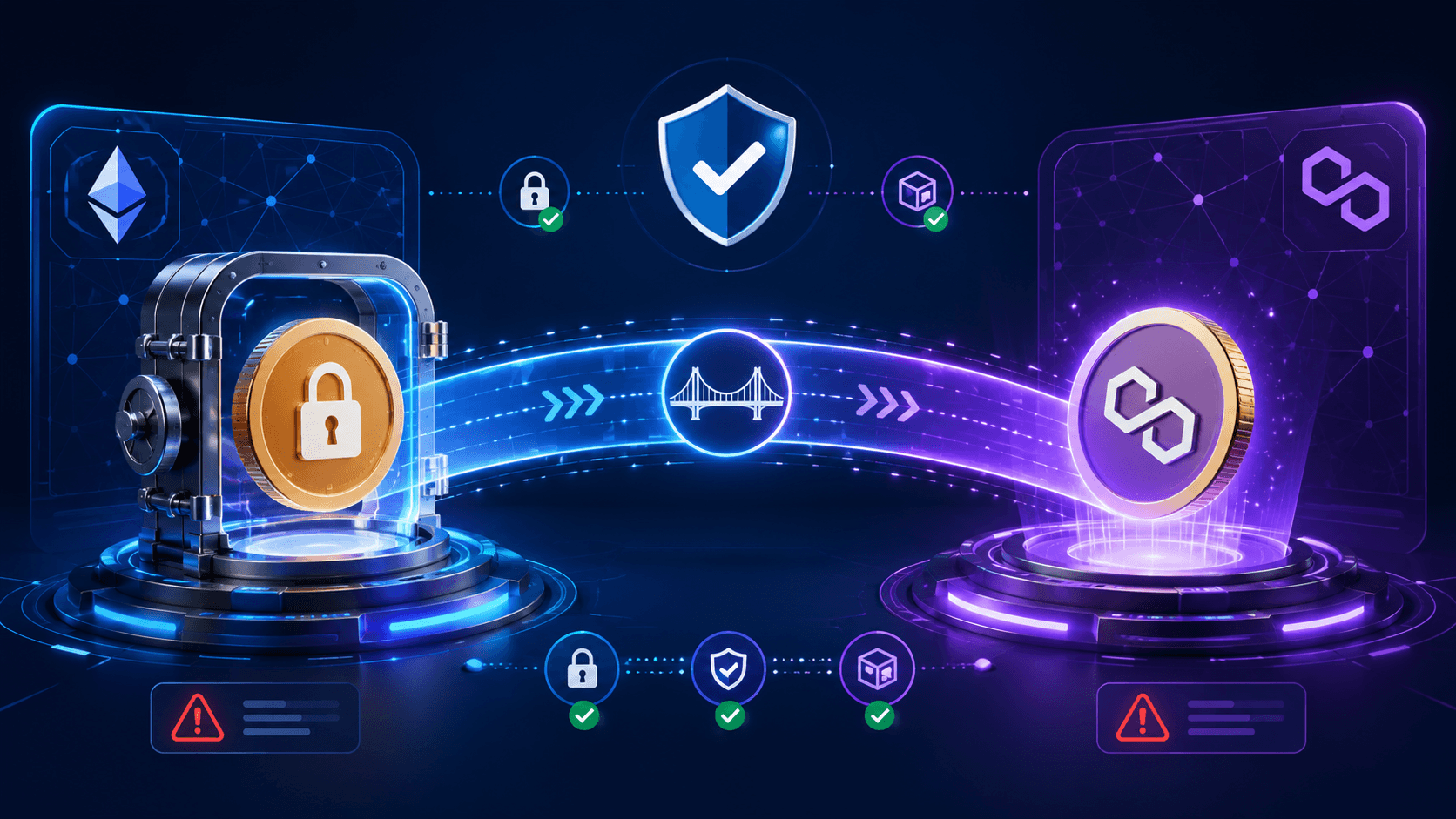
A lock-and-mint bridge locks your asset on the source chain and mints a wrapped version of it on the destination chain.
Here is what the flow looks like in practice:
You send 1 ETH into the bridge on Ethereum.
The bridge locks that ETH in a contract.
The bridge confirms the deposit happened.
A wrapped version of ETH is created on the destination chain.
You receive that bridged token in your wallet.
When you bridge back, the steps reverse. The wrapped token is burned, and the original ETH is unlocked and sent back to you.
Lock-and-Mint Model at a Glance
Component | Role | Main Risk |
Lock contract or custodian | Holds the original asset | If compromised, the backing collapses |
Verification system | Confirms the deposit happened | A fake or missed event can break the model |
Minting logic | Creates the bridged token | If exploited, attackers mint unbacked tokens |
Redemption process | Returns the original asset | Can stall during outages or market stress |
Why it is popular: It scales well and is used across many ecosystems.
Main weakness: It depends heavily on solid verification and good collateral management. If verification breaks, the bridge can mint tokens that are not actually backed by anything.
2. Liquidity Pool Bridges
A liquidity pool bridge usually does not mint a new token. Instead, it relies on pools of money already funded on both chains.
Here is the typical flow:
You deposit USDC on Chain A.
The bridge sees the deposit.
It uses funds already sitting in a pool on Chain B to pay you out.
You receive USDC from the destination pool.
Think of it less like printing a copy of your asset and more like a coordinated handoff between two pools of money.
Liquidity Pool Model at a Glance
Component | Role | Main Risk |
Source pool | Receives your deposit | Imbalance can mess with routing |
Destination pool | Pays out your funds | Thin liquidity means delays or worse pricing |
Routing logic | Picks the transfer path | Bad routing leads to execution problems |
Rebalancing system | Keeps both pools funded | Stress can leave one side dry |
Why it is attractive: It often feels simpler to use and avoids wrapped tokens entirely.
Main weakness: It only works as well as the liquidity behind it. During volatile markets, depth can shrink fast or get expensive.
Simple Bridge Flow Comparison
Step | Lock-and-Mint | Liquidity Pool |
1 | User sends asset on Chain A | User deposits asset on Chain A |
2 | Asset is locked in a contract | Bridge routing system detects transfer |
3 | Bridge verifies the deposit | Liquidity is pulled from pool on Chain B |
4 | Wrapped token is minted on Chain B | User receives payout from destination pool |
Both models solve the same problem. One leans on verification and asset backing. The other leans on liquidity depth and routing.
Why Bridge Security Is Hard
Bridge security is genuinely tricky because a bridge has to trust information from another blockchain.
That leads to one big question: how does the destination chain actually know that something happened on the source chain?
Bridges answer this question using validators, relayers, oracles, multisigs, light clients, or some mix of these. If that verification layer is weak or compromised, the entire bridge becomes unsafe.
Validator and Oracle Dependencies
Not all bridges are equally decentralized or equally trust-minimized. Some rely on a small validator set. Others use a multisig, oracle messaging, off-chain relayers, or light client verification. Each design comes with its own trust assumptions.
Dependency Type | What It Means | Main Concern |
Small validator set | Few actors confirm transfers | Risk of collusion or compromise |
Multisig control | A handful of keys can authorize actions | Stolen keys or insider failure |
Oracle-based messaging | External data validates events | Risk of bad or manipulated data |
Relayer network | Off-chain actors pass instructions | Trust placed in operators |
Light client verification | Direct cryptographic proof | Stronger model, but more complex |
The simple takeaway: if you cannot tell who verifies the bridge or how, do not trust it with funds you cannot afford to lose.
Is Bridge TVL a Good Sign of Safety?
TVL stands for total value locked. A lot of users treat TVL like a quick safety score, but that is not really what it tells you.
TVL Signal | Useful? | Limitation |
Strong usage | Yes | Popular bridges have still been hacked |
Deep reserves | Yes | Liquidity can vanish in a crisis |
Ecosystem relevance | Yes | Brand recognition can mask weak design |
Security quality | No | TVL is not an audit or a guarantee |
TVL is useful context, but it is not the same thing as security analysis.
8 Red Flags to Watch Before Bridging
# | Red Flag | Why It Matters |
1 | Unclear verification design | If the bridge does not explain how it validates messages, that is a problem |
2 | Tiny signer group | A bridge controlled by very few keys is more centralized and more fragile |
3 | Hidden incident history | If outages or exploits are hard to find, communication is poor |
4 | Aggressive incentives | High APY or promotions can distract you from the underlying risk |
5 | Thin destination liquidity | A bridge can technically work while still giving you bad pricing |
6 | New or untested routes | Fresh chain integrations carry more unknowns |
7 | Confusing token types | You should know if you are getting native, wrapped, canonical, or synthetic tokens |
8 | Silence during issues | Strong teams communicate during downtime, weak teams disappear |
Safer Bridging Habits
You cannot remove bridge risk completely, but you can lower it with a few simple habits.
Habit | Why It Helps |
Send a small test transfer first | Confirms the route, wallet, token, and timing |
Verify the exact token you received | Avoids confusion with wrapped or synthetic versions |
Use only official links | Cuts down phishing risk |
Check the bridge status page before use | Catches outages or active incidents |
Avoid bridging during heavy volatility | Congestion and stress make problems more likely |
Keep long-term holdings off active routes | Limits your exposure if something breaks |
For self-custody, many users like a hardware wallet to keep wallet-level risk low while still using DeFi. For market context, charting tools can help you keep an eye on volatility before moving size across chains.
Pre-Bridge Security Checklist
Run through these questions before you confirm a transfer:
# | Question |
1 | Is this a lock-and-mint bridge or a liquidity pool bridge? |
2 | Who verifies cross-chain messages? |
3 | Will I receive a native asset, a wrapped token, or a synthetic version? |
4 | Is destination liquidity deep enough for my transfer size? |
5 | Has the bridge had recent incidents or pauses? |
6 | Am I using the official link and the correct domain? |
7 | Have I tested the route with a small amount first? |
8 | Do I actually need to bridge, or is there a simpler path? |
Sometimes the safest move is not bridging at all. Using a different exchange route or just staying on the original chain can be simpler and safer.
Final Thought
Cross-chain bridges are a core part of modern crypto, but they are not neutral plumbing. They are trust systems built from code, verification logic, liquidity, operations, and human decisions. Every one of those layers can fail.
The goal is not to panic. The goal is to assess.
Frequently Asked Questions
How do crypto bridges work?
Crypto bridges move value between blockchains in one of two ways. They either lock an asset on one chain and mint a copy of it on another, or they use pools of money already sitting on both chains to complete the transfer.
Is bridging crypto safe?
It can be safe enough for many users, but it is not risk-free. Bridges are one of the higher-risk parts of DeFi infrastructure and have been the source of some of the largest hacks in crypto.
What is the difference between lock-and-mint and liquidity pool bridges?
Lock-and-mint bridges create a new bridged token after locking your original asset. Liquidity pool bridges use funds already available on the destination chain to pay you out, so no new token is minted.
Why are bridge exploits so common?
Bridges are complex because they have to verify information across separate blockchains. That extra complexity creates more attack surfaces, which is why so many exploits target bridges.
Does high TVL mean a bridge is safe?
No. High TVL shows that people are using the bridge, but it does not prove the design is sound or that the security has been properly tested.
What is the safest way to bridge?
There is no single safest bridge, but you can lower your risk by choosing transparent and well-tested bridges, checking liquidity depth, confirming what kind of token you will receive, and always sending a small test transaction first.
Disclaimer
This content is for educational and informational purposes only and is not financial advice. Nothing here is a recommendation to buy or sell any asset or use any platform. Do your own research and manage your risk.
Read more
Need deeper training?
Join our structured modules with live examples and expert checklists for effective implementation.
JOIN THE ACADEMY