Key Takeaways
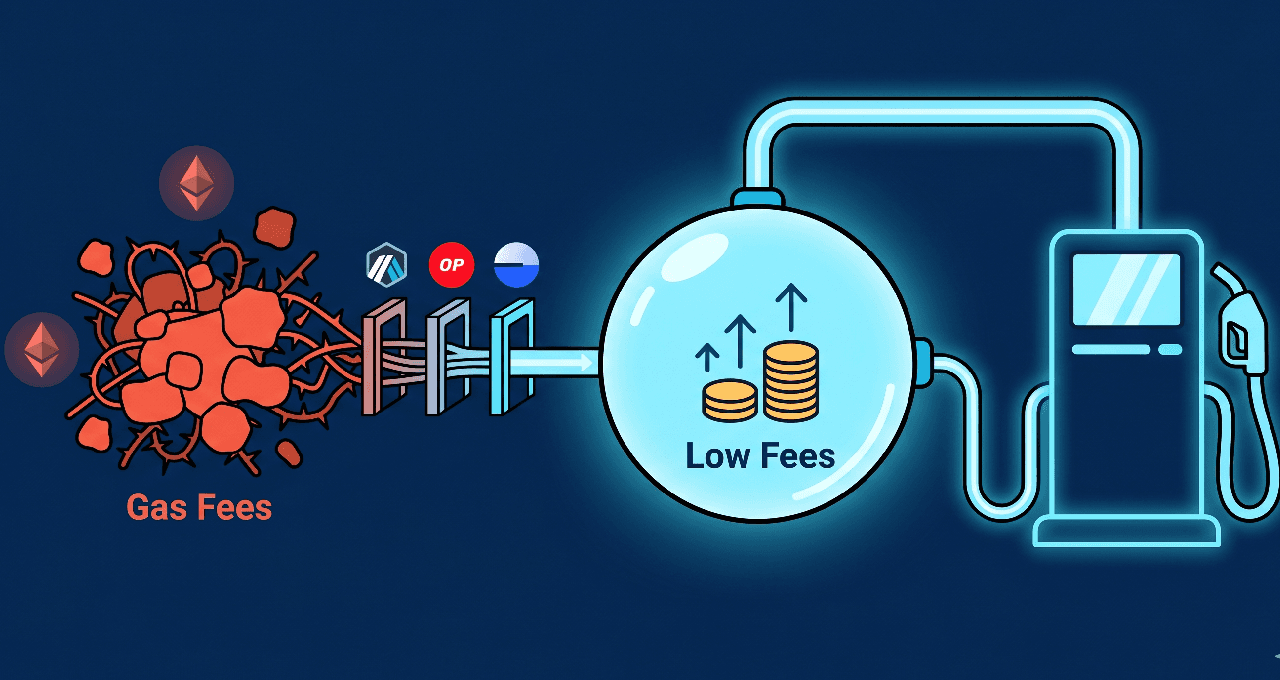
Gas fees are the small “processing charge” you pay every time you send crypto or use a smart contract – they reward the people who keep the network secure and stop spam.
Ethereum can get expensive during busy times, but Layer 2 networks (like Arbitrum and Base) make fees up to 95% cheaper while still using Ethereum’s strong security.
Solana keeps fees tiny (often under a cent), but it works differently from Ethereum, so you get speed and low cost with a slightly different level of security.
Every time you send crypto, swap tokens, or interact with a smart contract, you pay a small fee. On some networks it feels like nothing. On others it can actually cost more than the trade itself.
These fees are called “gas fees.” The name started with Ethereum, but now everyone uses it. Understanding gas fees helps you time your trades better, pick the right chain, and stop wasting money on simple actions.
This guide breaks everything down in plain English so you can feel confident choosing the best network for your trades in 2026.
What Is Gas and Why Does It Exist?
Gas is not a separate coin – it’s just a way to measure how much computer work a transaction needs.
Sending plain ETH uses a fixed 21,000 gas units.
Swapping tokens or minting an NFT can use millions of gas units because the smart contract does more heavy lifting.
The actual dollar cost you pay is:
Total Fee = Gas Units Used × Gas Price Per Unit
On Ethereum this price is shown in “gwei” (one gwei = 0.000000001 ETH).
Why do we even pay fees?
Validators and stakers who run the network need to earn something for their work. Without fees the network could be flooded with junk transactions, slowing everything down for real users. So fees pay the workers and keep spam away.
How Ethereum Gas Works: EIP-1559 Made Simple
Before 2021, Ethereum used a first-come-first-served auction. Everyone bid against each other and you often overpaid.
Then EIP-1559 changed the game with a two-part system that is much easier to understand:
Component | What It Is | Where the Money Goes |
Base Fee | Minimum fee set automatically by the network | Burned forever (removed from supply) |
Priority Fee (Tip) | Extra you can add for faster processing | Goes to validators |
The base fee rises or falls depending on how busy the network is. This makes fees more predictable than the old wild bidding wars. During busy times Ethereum also becomes slightly deflationary because some ETH gets burned.
Fees usually spike during big NFT drops, new token launches, or crazy market moves. In normal 2026 conditions you’ll see a few dollars to low double digits on Ethereum mainnet.
How Solana Handles Fees
Solana does things very differently – and that’s why it feels so cheap.
It has a fixed base fee of about 0.000005 SOL per transaction signature. At normal SOL prices that usually works out to less than one cent.
When the network gets busy, you can add an optional “priority fee” to jump the queue, but even then it rarely goes above a dollar.
Here’s a quick side-by-side:
Fee Type | Solana | Ethereum Mainnet |
Normal period base fee | Under $0.01 | $2 – $15 |
During congestion | $0.01 – $1 | $20 – $200+ |
Smart contract interaction | Very low | Moderate to high |
Solana gives you speed and tiny fees, but it uses a different security model with fewer validators than Ethereum.
Layer 2 Networks – The Smart Way to Use Ethereum Cheaply
Layer 2s (L2s) are the best solution for most beginners right now. They let you enjoy Ethereum’s security while paying a fraction of the fees.
Popular L2s in 2026: Arbitrum, Optimism, Base, and zkSync.
How they save you money:
They bundle hundreds or thousands of your transactions together, then send one cheap summary back to Ethereum. The mainnet cost gets split across everyone in the batch – so your fee drops dramatically.
Here’s the difference between the two main types of L2s:
Type | Examples | How It Works | Finality Speed |
Optimistic Rollups | Arbitrum, Optimism, Base | Assume transactions are good; can be challenged for 7 days | A bit slower |
ZK Rollups | zkSync, Scroll, Starknet | Use math proofs to prove transactions instantly | Very fast |
L2 Fee Comparison (2026 Average Ranges)
Network | Simple Transfer | Token Swap | Best For |
Ethereum Mainnet | $3 – $15 | $10 – $50 | Maximum security |
Arbitrum One | $0.05 – $0.30 | $0.10 – $0.80 | Highest TVL, most apps |
Optimism | $0.05 – $0.30 | $0.10 – $0.80 | Easy for beginners |
Base | $0.01 – $0.10 | $0.05 – $0.30 | Super cheap, Coinbase backed |
zkSync Era | $0.05 – $0.40 | $0.10 – $1.00 | Fast finality |
Solana | Under $0.01 | Under $0.10 | Lowest fees overall |
The Game-Changing Dencun Upgrade
In March 2024 Ethereum rolled out the Dencun upgrade (EIP-4844). It created cheap “blobspace” for L2 data. Result? Many L2 fees dropped 80–90% overnight. Everyday trading on L2s became even more affordable.
How to Minimize Gas Fees – 5 Beginner-Friendly Tips
Time your trades
Fees are usually lower on weekends and late at night (UTC). Check a gas tracker before you click.Move to an L2
Do all your DeFi activity (swaps, lending, liquidity) on Arbitrum, Base, or Optimism and save up to 95%.Set a sensible gas limit
Most wallets let you set a maximum. This stops you from overpaying if the network suddenly gets busy.Batch actions when possible
Some apps let you do several things in one transaction so you pay the base fee only once.Avoid peak times
Big NFT launches or market crashes = higher fees across the board. If it’s not urgent, wait a few hours.
Gas Tracking Tools (Rated for Beginners 0–5)
Tool | What It Does | Beginner Rating (0–5) | Why I Rate It |
Etherscan Gas Tracker | Real-time Ethereum gas prices + charts | 5 | Super simple and trusted |
Multi-chain gas prices | 4 | Clean but slightly more technical | |
Compares fees across all L2s | 5 | Perfect one-stop comparison | |
Blocknative Gas Estimator | Advanced predictions | 3 | Great for pros, a bit much for total beginners |
Gas data alongside price charts | 5 | Excellent if you already trade on TradingView |
FAQ
Q: What happens if I set my gas price too low?
A: Your transaction will either sit waiting a long time or get dropped completely. Most wallets warn you first.
Q: Why did I pay gas even though my transaction failed?
A: Gas pays for the computer work that already happened. Even if the contract hits an error, the validators still did their job.
Q: Is gas the same as a network fee?
A: On Ethereum yes. Other chains call it “transaction fees” or “priority fees.” “Gas” is the Ethereum term but everyone understands it now.
Q: Do hardware wallets cost extra gas?
A: No. The fee depends only on the transaction itself, not whether you sign it on a Ledger or in your phone wallet.
Q: Can I get a gas refund?
A: Yes! Ethereum refunds any unused gas automatically. You only pay for what was actually used.
Disclaimer: This content is for educational and informational purposes only and is not financial advice. Nothing here is a recommendation to buy or sell any asset or use any platform. Do your own research and manage your risk.
Read More
How Withdrawal Fees Affect Your Overall Trading Costs
Top 5 Cryptocurrency Payment Gateways for Beginners
Understanding Ethereum Gas Fees: Your Guide to Transaction Costs
Need deeper training?
Join our structured modules with live examples and expert checklists for effective implementation.
JOIN THE ACADEMY