
Key Takeaways
# | Takeaway |
|---|---|
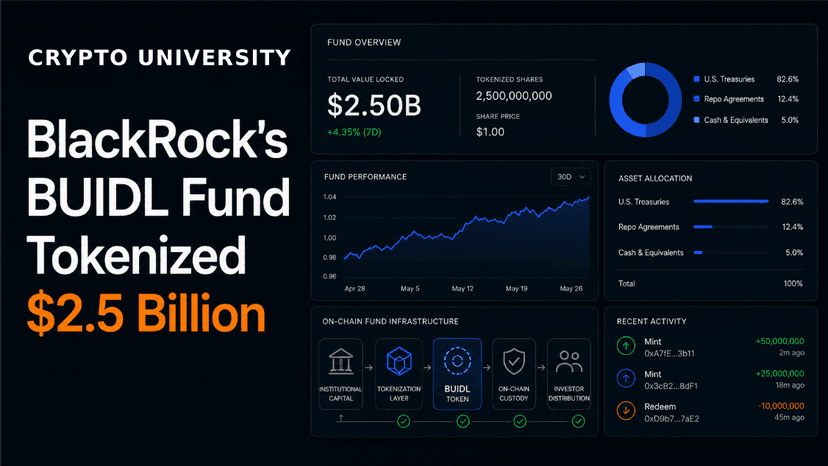
1 | BlackRock's BUIDL fund is the largest real-world example of tokenized US Treasuries, holding over $2.5 billion in assets and proving that institutional-grade finance can run on a blockchain. |
2 | The fund uses a legal wrapper (a traditional fund structure) combined with smart contracts, so investors get the safety of regulated finance plus the speed and transparency of on-chain technology. |
3 | Daily yield is distributed automatically as new tokens directly to wallets, no waiting, no manual processing which shows how DeFi mechanics can dramatically improve traditional asset management. |
What Is the BlackRock BUIDL Fund?
If you have been following crypto news, you have probably heard the term "tokenized Treasuries" thrown around. But what does that actually mean in practice? BlackRock's BUIDL fund is the best real-world example to help us understand.
Launched in March 2024 on the Ethereum blockchain, BUIDL, which stands for BlackRock USD Institutional Digital Liquidity Fund, is a money market fund that invests in US Treasury bills, cash, and repurchase agreements. These are some of the safest, most stable financial instruments in the world.
The twist is that ownership of the fund is represented as tokens on the Ethereum blockchain instead of traditional paper shares. By June 2024, the fund had grown to over $2.5 billion in assets, making it the largest tokenized Treasury fund in the world.
Why Does This Matter for Traders?
For beginner traders, here is the simple version: Imagine being able to hold US government bonds, one of the safest investments on earth, but as a digital token in your crypto wallet. You earn daily interest, you can transfer it in seconds, and everything is recorded transparently on a blockchain.
That is exactly what BUIDL does. It bridges the gap between the traditional financial world (often called TradFi) and decentralized finance (DeFi). This is a big deal because it shows that large institutions are taking blockchain technology seriously as real financial infrastructure, not just speculation.
The Legal Structure. How Is It Set Up?
One of the first questions people ask is: "Is this actually safe and legal?" The answer is yes, and here is why.
BUIDL is set up as a traditional regulated fund under securities law. BlackRock, one of the world's largest asset managers, is the fund manager. The fund is custodied by BNY Mellon, a major global bank. Securitize, a licensed securities firm, acts as the transfer agent, meaning they manage who owns what shares.
Only investors who pass strict identity checks (called KYC, Know Your Customer) and qualify as "accredited investors" can participate. The minimum investment is currently $5 million.
Role | Who Fills It | What They Do |
|---|---|---|
Fund Manager | BlackRock | Manages the fund, invests in Treasuries |
Custodian | BNY Mellon | Holds the actual Treasury bonds safely |
Transfer Agent | Securitize | Manages token issuance and investor records |
Blockchain | Ethereum | Records ownership and automates yield |
Auditor | PricewaterhouseCoopers | Verifies the fund's financials |
This layered structure means BUIDL gets the best of both worlds: the legal protections of a traditional fund AND the efficiency of blockchain technology.
How the Smart Contract Works
The technology behind BUIDL is what makes it truly innovative. Let's break it down in plain English.
The BUIDL token is built on the ERC-20 standard, the same token standard used by thousands of other Ethereum tokens. However, it has some important extra rules programmed in to comply with securities laws.
Built-In Compliance Rules
Feature | What It Means for You |
|---|---|
Whitelisted Wallets Only | Only pre-approved wallet addresses can hold or receive BUIDL tokens, no anonymous transfers |
Transfer Restrictions | Tokens can only be transferred to other approved investors |
Freeze Function | BlackRock can freeze tokens if required by law (e.g., a court order) |
Force Transfer | Tokens can be moved by BlackRock in regulatory situations |
Upgradeable Contract | The smart contract can be updated to comply with future regulations |
Think of it like a members-only club. The token might live on a public blockchain, but you can only participate if you have been vetted and approved.
How Yield Is Distributed. The Part That Makes DeFi Fans Excited
Here is one of the most interesting parts of BUIDL: how it pays interest to token holders.
Traditional money market funds distribute interest monthly and require a lot of administrative work. BUIDL does it differently. Every single day at midnight UTC, the smart contract automatically mints new BUIDL tokens and distributes them directly to token holders' wallets.
So if you hold 1,000,000 BUIDL tokens and the fund earns a 5% annual yield, you will receive approximately 137 new tokens deposited to your wallet every day (5% ÷ 365 days = 0.0137% daily).
This is like receiving interest payments automatically, every day, directly to your wallet, no paperwork, no waiting for a bank to process it.
The BUIDL token itself always stays at $1 per token. The yield comes from receiving more tokens, not from each token increasing in price. This design makes BUIDL what is called a "stable-value" fund.
Redeeming Your Tokens. Getting Your Money Back
Blockchain-based assets are only useful if you can get your real money back easily. BlackRock solved this with a dedicated liquidity facility.
Redemption Path | How It Works | Speed |
|---|---|---|
Standard Redemption | Submit a redemption request to Securitize; funds transferred via traditional bank wire | Next business day |
Circle USDC Swap | Swap BUIDL tokens for USDC stablecoin using Circle's liquidity pool | Near-instant (24/7) |
The Circle partnership is particularly powerful. Circle maintains a $100 million USDC pool specifically for BUIDL redemptions. This means institutional investors can move between BUIDL and on-chain liquidity at any time, even on weekends when traditional banks are closed.
How BUIDL Is Being Used in the Broader DeFi Ecosystem
This is where things get really exciting for the crypto world. BUIDL is not just sitting still in wallets, it is being integrated into DeFi protocols as collateral.
Protocol | How They Use BUIDL |
|---|---|
Ondo Finance | Wraps BUIDL into OUSG tokens, making it accessible to a wider range of investors |
Superstate | Uses similar structure for their tokenized Treasury products |
Various DeFi Protocols | Accept BUIDL as collateral for loans, meaning you can borrow against your Treasury position |
This is the dream scenario for the tokenized asset world: a BlackRock-backed, Treasury-secured token that can be used as collateral in DeFi protocols. It brings institutional-grade stability to the DeFi ecosystem.
What This Signals for the Future of Asset Management
BUIDL is more than just one fund, it is a proof of concept that is changing how the financial industry thinks about asset management.
Here is what it tells us about where things are heading:
Traditional finance and DeFi are converging. The wall between TradFi and crypto is coming down, one tokenized asset at a time.
Efficiency gains are real. Automated daily yield distribution, instant settlement, and 24/7 redemption options are genuine improvements over legacy systems.
Regulation is being built in from the start. Rather than fighting regulators, BUIDL's design embraces compliance, which could be the template for future tokenized securities.
The door is opening for retail. While BUIDL itself requires $5M minimum, the protocols built on top of it (like Ondo) are packaging it into products with much lower minimums.
Frequently Asked Questions (FAQ)
Can I personally invest in BlackRock's BUIDL fund?
As of now, no, unless you are an institutional investor or ultra-high-net-worth individual. The minimum investment is $5 million, and you must be a qualified purchaser. However, protocols like Ondo Finance are creating products built on BUIDL that may have lower minimums.
Is BUIDL a cryptocurrency?
Not exactly. BUIDL is a tokenized security, a traditional regulated fund whose shares are represented as tokens on the Ethereum blockchain. It is backed by real US Treasury bonds, not by speculation. Think of it as a traditional fund with a blockchain-powered backend.
What happens if Ethereum goes down or has issues?
The underlying Treasury bonds are held by BNY Mellon regardless of what happens on Ethereum. If there were a major blockchain issue, BlackRock has contingency plans built into the legal structure to protect investors. The blockchain is the delivery mechanism, not the asset itself.
How is BUIDL different from a regular money market fund?
Feature | Regular Money Market Fund | BlackRock BUIDL |
|---|---|---|
Yield Distribution | Monthly | Daily (automatic) |
Settlement | 1–2 business days | Near-instant (via USDC) |
Transparency | Quarterly reports | Real-time on-chain data |
Trading Hours | Business hours only | 24/7 available |
Collateral Use | Very limited | DeFi integration possible |
What is RWA tokenization?
RWA stands for Real-World Assets. Tokenization means taking a traditional asset, like a Treasury bond, real estate, or private equity and creating a digital token on a blockchain that represents ownership of that asset. BUIDL is one of the most prominent examples of RWA tokenization in practice.
Why did BlackRock choose Ethereum?
Ethereum is the most widely used blockchain for financial applications. It has the largest developer ecosystem, the most established DeFi protocols, and the most institutional infrastructure (custody, compliance tools, etc.) built around it. This makes it the natural choice for a product that needs to integrate with the broader DeFi ecosystem.
What are the risks of investing in tokenized Treasuries?
Smart contract risk: A bug in the code could theoretically cause problems (though BUIDL uses audited, well-tested contracts)
Regulatory risk: Securities regulations around tokenized assets are still evolving in many countries
Counterparty risk: You are relying on BlackRock, BNY Mellon, and Securitize to all perform their roles correctly
Liquidity risk: While the Circle facility helps, large-scale redemptions could take time to process
Disclaimer: This content is for educational and informational purposes only and is not financial advice. Nothing here is a recommendation to buy or sell any asset or use any platform. Do your own research and manage your risk.